
How to Buy an Expandable Hose That Actually Survives the Season
Most pocket hoses die at the same three spots: the coupling, the inner tube, and the shutoff. Here is what to check before you buy, and how to make whichever hose you own last years instead of weeks.

Nathan Pierce
August 10, 2026 · 6 min read
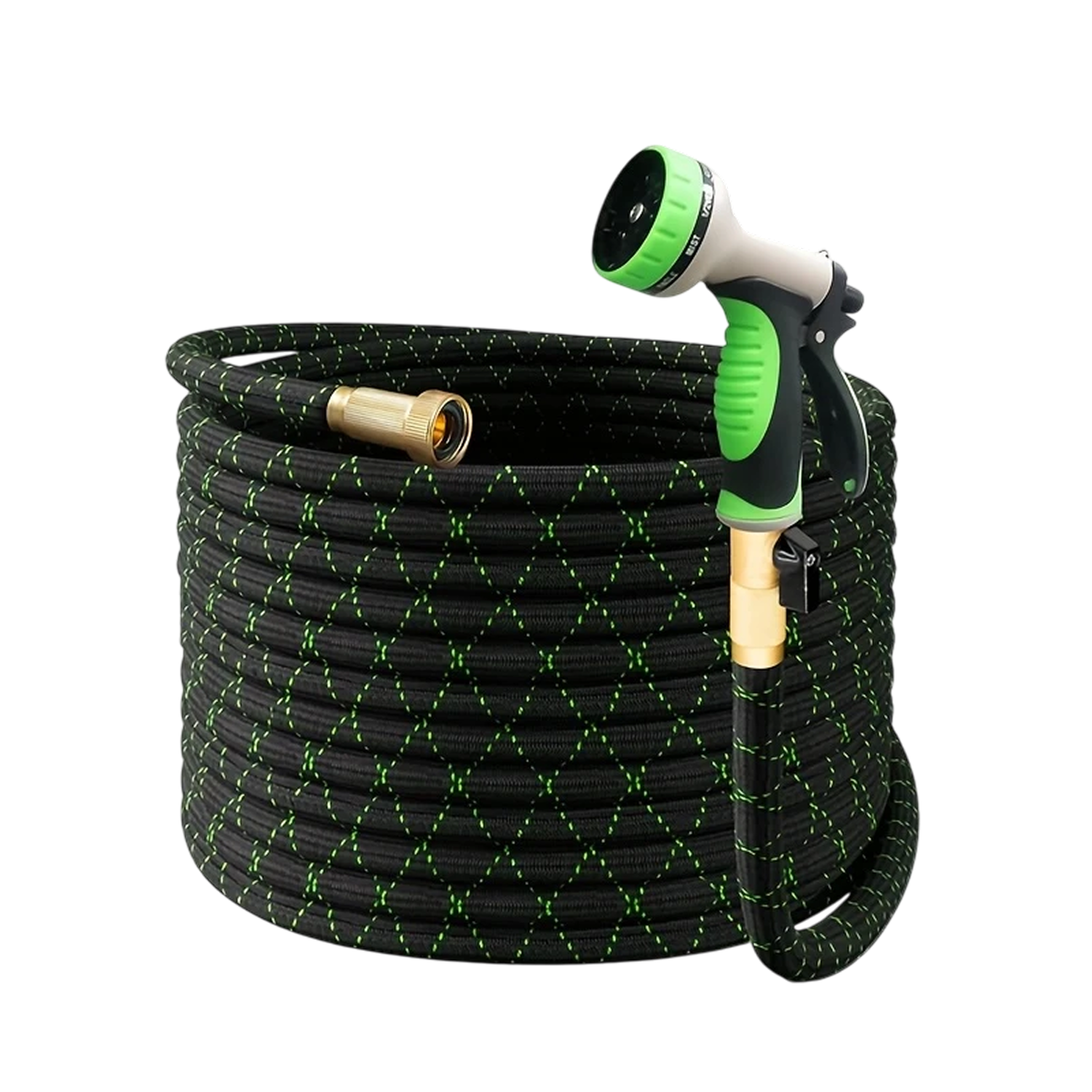
Expandable hoses earn their bad reputation one failure mode at a time. The latex inner tube pops at the coupling, the plastic fittings crack after a summer of sun, or the whole thing bursts the first time you leave the nozzle closed with the water on. None of that is bad luck — it is a parts list problem, and you can read it off the product page before you spend a dollar.
The three parts that decide everything
- Couplings: solid brass or nothing. Aluminum couplings gall and cross-thread; plastic ones crack at the hose bib where torque is highest. Brass threads onto a standard 3/4-inch faucet smoothly and survives being stepped on.
- Inner tube: look for multi-layer latex (three layers or more). Single-layer tubes are what burst when pressure spikes with a closed nozzle.
- Shutoff valve: a valve at the hose end lets you depressurize before disconnecting — the single habit that most extends an expandable hose's life.
Pressure ratings, translated
Home water pressure in the US usually sits between 40 and 80 PSI. A hose that only quotes a burst rating near that range has no safety margin — closing the spray nozzle briefly spikes pressure well above street level. Look for a working-pressure claim comfortably above your street pressure, and treat any listing that hides PSI entirely as a warning sign.
Field note
After each use, open the nozzle, shut the faucet, and let the hose drain and contract before storing it. Storing an expandable hose pressurized is the fastest way to kill the inner tube — it is the difference between one season and five.
What we stock, and why
We carry one expandable hose, and the parts list is the reason: solid brass ends on both sides, a triple-layer core rated far past household pressure, and a metal shutoff at the nozzle end. It packs down small enough for a porch bin, which is the other half of surviving winter.
Tested pickBrassCoil$99.99ViewMake any hose last longer
- Never leave it pressurized overnight — drain after every session.
- Keep it off hot pavement; UV plus heat ages latex fastest.
- In freezing climates, store it indoors — expansion ice cracks couplings first.
- Use a rubber washer with a screen if your water carries grit; debris cuts tubes from the inside.
A hose is a pressure vessel you happen to water plants with. Buy it like one.