Gutter Cleaning: How to Clear Gutters From the Ground or a Ladder
Plan gutter cleaning twice a year, in late fall and spring. Use a telescopic ground tool for reachable rooflines and a ladder only on firm, level footing.
The Cobalt Hollow Team
November 19, 2026 · 9 min read

Gutter cleaning comes down to timing and reach. Clear the channels in late fall after the leaves drop and again in spring, then use a telescopic ground tool for single and two-story rooflines, or a correctly set ladder when you need to see and reach by hand. Check again after any major storm.
This guide gives you a month-by-month calendar, a step-by-step choice between ground and ladder, a ladder safety checklist, and the factors that set what a hired crew charges. Clogged gutters send water over the edge and down the siding, so the schedule matters as much as the method.
When to Do Gutter Cleaning: A Seasonal Calendar
Plan on two full cleanings a year, with extra checks tied to weather. The exact month depends on the trees around your house and your climate. Oaks, maples and pines drop material on different schedules, so adjust the dates below to what you see landing on your roof.
| Time of year | What to do | Why it matters |
|---|---|---|
| Early fall (September) | Look for early leaf drop, seed pods and pine needles; clear any visible clumps | Heavy autumn rain meets a channel that is already partly full |
| Late fall (October to November) | Full cleaning once most leaves are down and before the ground freezes | Frozen debris holds water and adds weight to the gutter system |
| Midwinter thaw | Look from the ground at icicles, sagging runs and ice at the eaves | Blocked channels and downspouts are linked to ice dams |
| Spring (April to May) | Full cleaning after the thaw and after trees shed buds and seeds | Winter leaves the channel with packed silt and wet moss |
| After a big storm | Spot check downspout outlets and low corners | Branches and shingle grit collect at the outlet |
In colder areas such as Chicago, finish the fall pass before the first hard freeze. Wet leaves frozen to the channel floor are hard to move, and you cannot flush a frozen downspout.
If you have large trees overhanging the roof, add a mid-summer check and a second fall pass in late November. Homes with gutter guards still need a look each season, since fine debris and seed pods settle on top of the guards or slip through them.
Signs Your Gutters Need Cleaning Now
You do not need to wait for the calendar if the house shows the signs. Walk the perimeter during or just after a rain and look for these:
- Water spilling over the front edge instead of running to the downspout
- Plants, grass or seedlings growing out of the channel
- Dark streaks or stains on siding below the gutter line
- Sagging sections, or gutters pulling away from the fascia
- Water pooling beside the home foundation after rain
- Birds, wasps or rodents entering and leaving near the roofline
- Soggy mulch or washed-out soil under the eaves
Any of these means water is not reaching the downspouts. Left alone, that can lead to water leaks at the fascia, roof leaks near the eaves, rotted trim and costly damage to siding and the basement wall.
Ground Tool or Ladder: Decision Steps
The right method matches your roof height, the debris and your comfort at height. Work through these steps in order.
- Measure or estimate the gutter height. Single-story eaves and many porch or garage runs are within reach of a pole tool. Two-story rooflines also work with a pole that has extension sections.
- Look at the debris from the ground. Loose dry leaves, pine needles and light grit can be swept or blown. Wet moss and packed silt need bristles or hand scooping.
- Check the ground around the house. A ladder needs firm, level footing. Sloped lawn, soft soil, flower beds and steps argue for staying on the ground.
- Check the roof pitch and the gutter material. Steep roofs and slick surfaces make a ladder hard to position. Follow the gutter manufacturer's manual on how much load the brackets can take.
- Decide whether you need to see inside. If you suspect a leaking seam, a loose hanger or a hidden clog in the downspout elbow, a ladder lets you inspect it up close. Otherwise, ground reach does the job.
- Know your limit. If the roofline is very high, steep, icy or wet, or you are unsure about a ladder, hire a local professional rather than improvise.
| Factor | Ground tool | Ladder |
|---|---|---|
| Reach | Set by pole length and sections | Set by ladder height and placement |
| Visibility inside the channel | Partial view; you feel resistance and watch what falls | Direct view; you can check seams and hangers |
| Ground conditions | Works on uneven lawn if you keep your footing | Needs firm, level support and a helper |
| Moving along the house | Walk along the wall | Climb down, move and reset the ladder at each stop |
| Repairs and sealing | Not suited to repairs | Needed for hands-on fixes |
Cleaning Gutters From the Ground
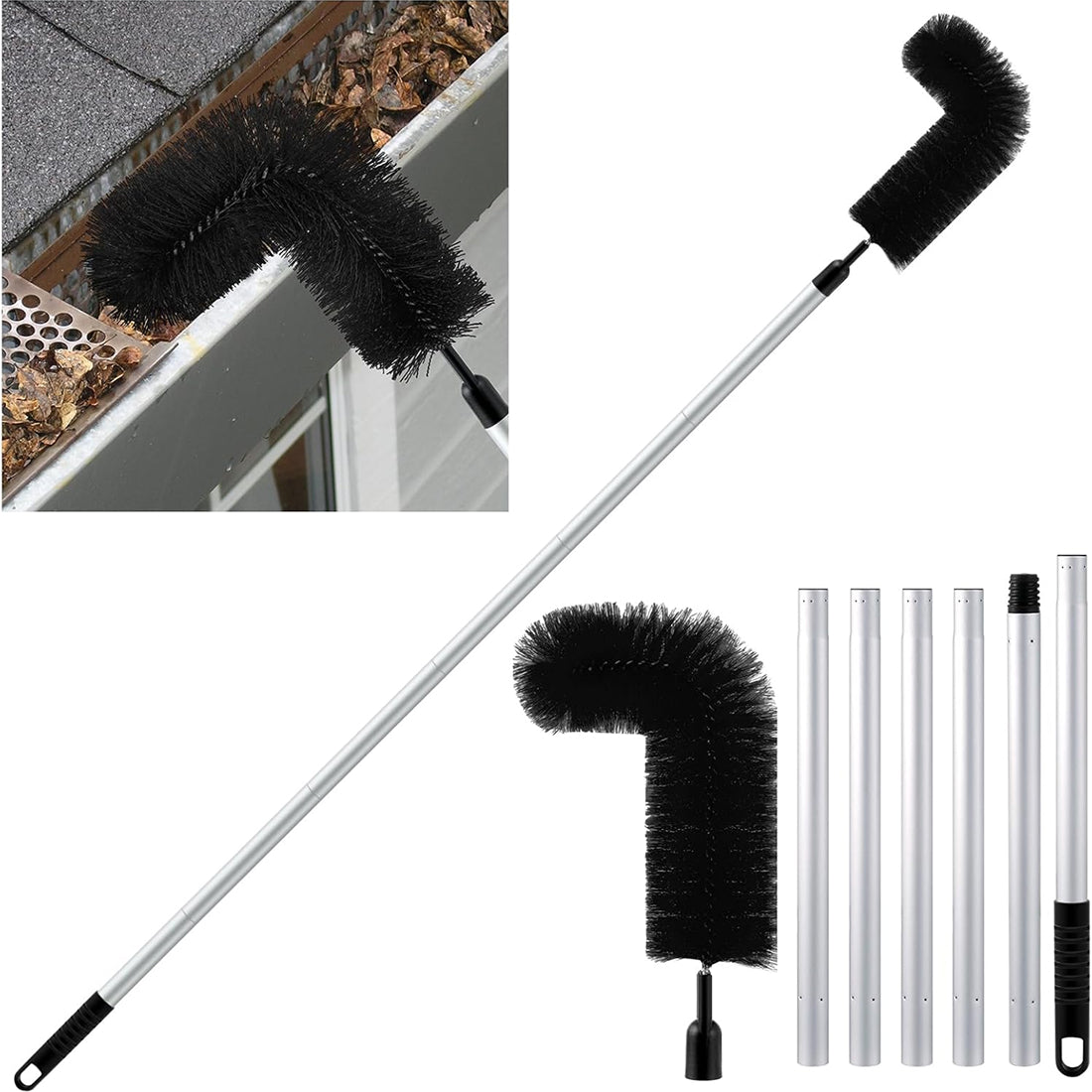
A ground tool keeps both feet on the lawn. A gutter cleaning wand has a long pole and an angled head that sweeps the channel as you walk along the wall.
The SkyReach is a gutter cleaning wand with a telescopic pole, modular extension sections and a bendable 90° head fitted with PET bristles. You extend it to the height of your gutter and sweep leaves, moss and debris out of the channel. The aluminum pole has a textured grip, and the extension sections add or come off so you can set the length for a porch, garage or main roofline.
 In this guideSkyReach$49.99View

Ground-cleaning steps
- Clear the ground below the gutter line of toys, hoses, furniture and planters, and lay a tarp on the lawn or beds to catch debris.
- Wear eye protection and gloves. Debris can drop straight onto your face when you look up.
- Extend the pole until the head reaches the gutter, adding extension sections if needed. Follow the manual to assemble the sections.
- Bend the 90° head to the angle that fits the corner, bracket or downspout opening.
- Start at the end farthest from the downspout. Sweep the debris toward the outlet in short, overlapping strokes, and keep the pole away from power lines and the service entrance cable.
- Pull any wet moss or packed silt along the channel floor with the bristles and let it fall onto the tarp.
- Clear the downspout opening last so you are not pushing debris into an outlet that is already blocked.
Work at a pace that gives your arms rests when the pole is overhead. Rest between runs, and stop if wind picks up or the pole starts to sway.
Other ground options
Some people use a blower with a long extension for dry leaves. That works only on loose, dry material, and it throws debris across the yard. If you already own a cordless blower, see our breakdown of cordless blower weight, airflow and battery trade-offs before you use it overhead. Pressure washers and spray wands can rinse the channel, but aimed upward they push grit under shingles and into siding, so check your manual first.
For the rest of your seasonal yard work, browse the Lawn, Yard & Snow Care collection.
Field note
Do the first pass before you flush anything. Remove the bulk of the debris dry, then rinse with a hose to confirm water runs freely to the downspout outlet.

Ladder Safety Checklist
A fall from a ladder is the main hazard to plan around, and no gutter is worth one. If you do use a ladder, go through this list every time. It is general guidance; follow the ladder's manual and its load label.
- Pick a ladder tall enough that you are not standing on the top two rungs
- Set it on firm, level ground, with the feet fully open and locked
- Use a stabilizer or standoff so the ladder rests on the wall, not on the gutter
- Have a helper hold the base and hand up tools
- Keep your belt buckle between the side rails and do not lean out
- Wear shoes with grip and gloves for sharp metal edges
- Check for power lines and the service cable before you raise the ladder
- Skip the job when the surface is wet, icy or windy
- Move the ladder instead of stretching to the side
- Carry a small bucket or hook for debris so one hand stays free for the ladder
If anything on this list is missing, switch back to a ground tool or hire help.
Clearing the downspout
The downspout is a common place for clogs to settle. Check that the outlet at the bottom discharges away from the foundation. Run a garden hose from the top of the downspout, as long as water is not freezing, and watch the bottom outlet. If water backs up, a plumber's snake or a light tap on the elbows can loosen a plug. Disconnect and drain the hose before cold weather.
For the spigot end of that hose, our guide to hose bibs, anti-siphon and frost-free types explains what to look for before the first freeze.
What Gutter Cleaning Costs and When to Hire
Quoted prices change by region and season, so we do not list figures here. What you can learn is what shapes the quote. Use these factors to compare estimates and to decide whether to do it yourself.
| Factor | How it affects the quote |
|---|---|
| Length of gutters | Crews often price by the linear foot, so longer runs cost more |
| House height | Two- and three-story homes need more equipment and time |
| Gutter type | Seamless gutters, half-round and box styles differ in access |
| Roof slope | Steep pitches are harder to work around |
| Condition | Sagging, rusted or leaking sections add repair work |
| Gutter guards | Guards may need to be lifted and replaced |
| Add-ons | Roof rinsing, downspout flushing or repairs are separate line items |
| Season and travel | Fall is busy; distance to the property can add a fee |
When you call a roof and gutter cleaner or a local crew, ask whether the quote covers downspouts, debris haul-away and a check of the seams. A Chicago gutter cleaner, like any local service, can tell you how the area's freeze timing affects scheduling. Ask for the quote in writing and confirm they carry liability coverage.
Hiring makes sense when the roofline is high or steep, the roof has moss or loose shingles, you have repair needs, or you are not comfortable on a ladder. For routine upkeep on a single or two-story house, a pole tool lets you handle the seasonal pass yourself.
Common Mistakes and Care Schedule
Blocked gutters often trace back to a few repeat errors. Avoid these:
- Waiting until the last leaf drops in a year with heavy tree cover
- Pushing debris into the downspout instead of lifting it out
- Leaning a ladder on the gutter, which can bend the channel
- Using a pole near power lines
- Skipping the water test after cleaning
- Ignoring a sagging run or a seam that drips
- Leaving debris on the roof edge, where the next rain washes it back in
Keep a simple schedule. Check at the start of each season, clean in late fall and spring, run water through the downspouts after every cleaning, and trim branches that hang over the roof. Note any leaking seam or loose hanger in a list and fix it before the next freeze.
Once the debris is on the tarp, bag it or add it to compost. Wet leaves and moss are heavy, so fold the tarp in from the corners and carry it in two loads if needed. Rinse your tools, let them dry and store the pole with its sections retracted.