
Standard Rain Gauge: Size, Placement and How to Record Rainfall
A standard rain gauge is a funnel and measuring tube with an 8-inch opening; 4-inch gauges are a common home size. Here is how to place it, read it and log rainfall for watering.
The Cobalt Hollow Team
November 15, 2026 · 7 min read
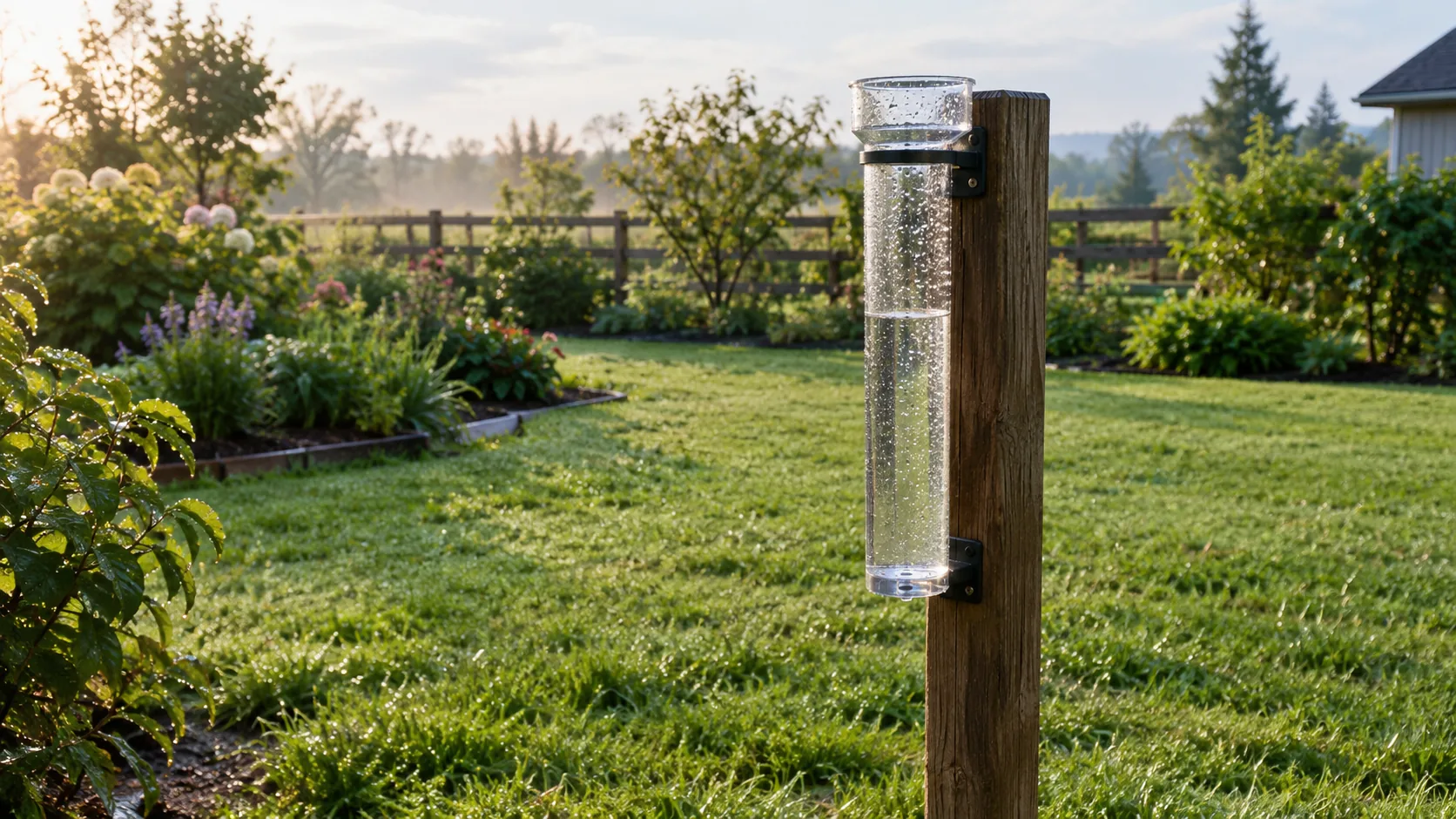
A standard rain gauge is a collecting funnel that feeds rain into a measuring tube, so you can read the depth of rainfall directly in inches or millimeters. The official size has an 8-inch opening, while a 4-inch gauge is a common home size. Either one works when it is mounted level, in the open, and read after each rain.
This guide covers the two sizes, the two basic types, a placement checklist, how to read tenths and hundredths, and how to turn your log into a watering decision.
What a rain gauge is and how it works
A rain gauge measures how deep rain would stand on flat ground if none of it ran off or soaked in. Rain enters a round opening of known size, and the water collected is measured as depth. One inch of rain means one inch of water over the whole area.
In a standard-style gauge, the funnel sends water into a narrow inner tube. Because the tube is narrower than the opening, a small amount of rain makes a tall column of water, which is easier to read than a shallow puddle. The markings on the tube are already scaled for this, so you read them as rainfall, not as the depth inside the tube.
The two types of rain gauges
The two types are non-recording and recording. A manual rain gauge, the non-recording kind, holds the water until you read and empty it. A recording gauge logs rainfall on its own, with no one standing at the post.
| Type | How it works | You do |
|---|---|---|
| Standard (manual) gauge | Funnel and measuring tube hold the rain | Read, record, empty |
| Tipping bucket | A small bucket fills, tips, and sends a signal for each tip | Check the display, clear debris |
| Weighing gauge | Collects rain in a container and records its weight | Found at official stations |
For a yard, the choice is between a hand-read standard gauge and an electronic sensor with a display.
Standard rain gauge sizes: 4-inch and 8-inch
Yes, there is a standard diameter. The official gauge used by weather observers has an 8-inch opening, as described in a national weather service page on the 8-inch rain gage. Its inner measuring tube holds 2 inches of rain, and extra water spills into the outer can, which you measure in portions.
There is no single standard for home use. A 4-inch gauge of the standard type follows the same design as the 8-inch official gauge at a smaller size: a funnel, an inner measuring tube and an outer overflow cylinder. It suits tracking your own garden, though you should not mix its readings with official 8-inch data. Some home gauges are one-piece clear tubes with a printed scale, which are a separate type and are read directly.
| Feature | 8-inch gauge | 4-inch gauge |
|---|---|---|
| Opening diameter | 8 inches (about 20 cm) | 4 inches (about 10 cm) |
| Reading | Funnel feeds the inner tube; measure it, and pour any overflow from the outer can into the tube in portions | Same funnel and inner-tube design at a smaller size; read the inner tube, and measure any overflow the same way |
| Typical use | Observer networks | Home gardens and lawns |
| Upkeep | Empty and rinse funnel and tube | Empty and rinse funnel and tube |
On accuracy: no single model decides it. Readings depend on a level mount, a clear site, a clean funnel and reading at eye level. A carefully placed small gauge gives a usable record, while a badly placed large one does not.
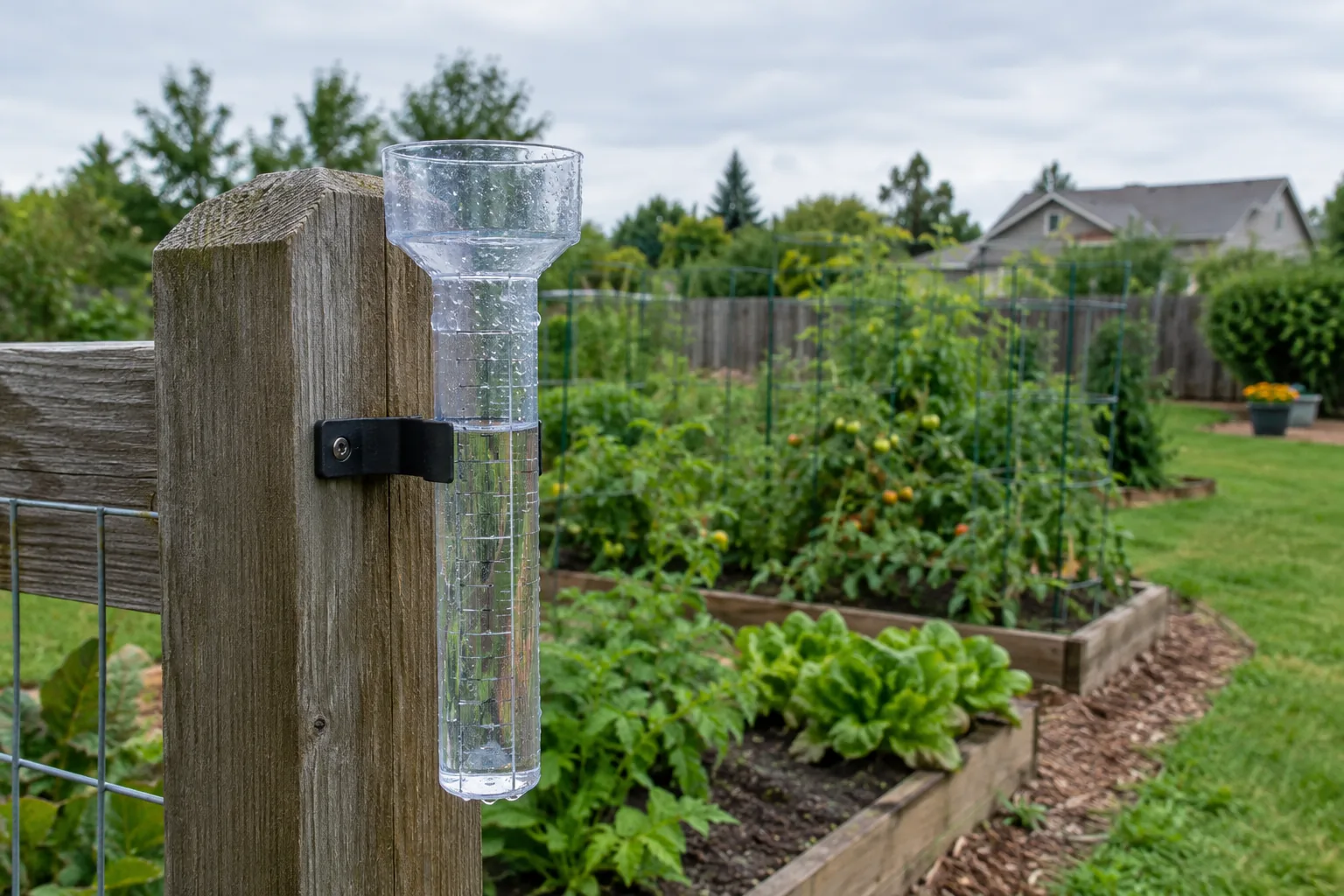
Placement checklist for a standard rain gauge
Where you put the gauge changes what it catches. Walk your yard with this list before you drive in the post.
- Pick an open area away from trees, walls and eaves. A common rule of thumb is a distance of at least two to four times the height of the nearest obstacle.
- Mount it on a post or rail so the opening sits a few feet above the ground, which keeps soil splash out of the opening. Check the manual for the height it lists.
- Make the rim level. Use a small level across the top.
- Fasten it firmly so wind does not tip it.
- Keep it away from sprinklers and downspouts, which add water that is not rain.
- Choose a spot you can reach on foot after a storm. For an electronic sensor, follow the setup steps in its manual.
Clean the funnel and tube on a regular schedule: rinse after dust, pollen or leaf fall, and empty the tube after each reading so the next one starts at zero.
Field note
Set the opening above the ground and level, then check it with a small level each season, since posts shift as the soil freezes and thaws.
How to read a rain gauge in inches, tenths and hundredths
Read the gauge as soon after the rain ends as you can, with your eye level with the water surface. Water curves slightly at the edges, so read the flat bottom of that curve, called the meniscus.
Reading in inches
Marked lines are tenths of an inch on many scales, with longer lines at whole inches. If the water sits at the second line above 1, the reading is 1.2 inches.
Reading in tenths and hundredths
Each tenth is split into ten hundredths. A level halfway between 0.3 and 0.4 reads 0.35 inch. In both 4-inch and 8-inch standard-style gauges, the inner tube is magnified, so a hundredth of an inch of rain shows as a tenth of an inch of water in the tube, and the scale is printed to account for it. On a simple one-piece direct-read tube, read to the nearest marked line and estimate between lines only if the scale allows it.
Reading in millimeters
A metric gauge marks millimeters, and 1 inch equals 25.4 mm. So 0.25 inch is about 6.4 mm, and 10 mm is about 0.39 inch. Use one unit in your log so totals add up.
Log rainfall to decide when to water
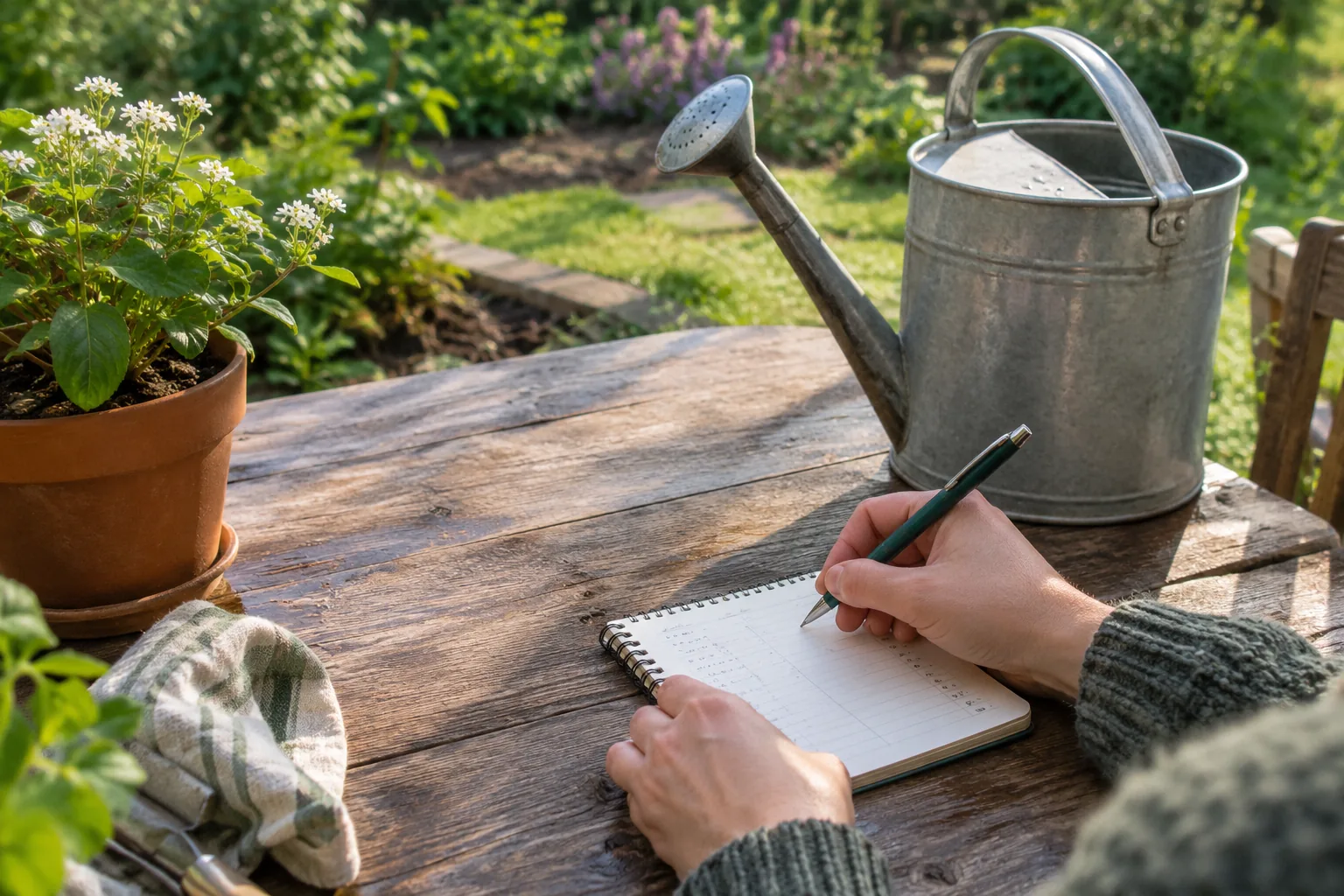
A notebook column is enough. Record the date, the time you read it, the amount, and a note such as drizzle, storm or sprinklers on. Take the reading at the same time each day, and empty the gauge afterward.
- Set a weekly water target for the plants you grow, from the plant label or your local extension office.
- Add up the rain logged over the past seven days.
- Subtract that total from the target. If rain covered the target, skip irrigation.
- If it fell short, water to make up the difference and note it in the log.
Heavy storms can run off hard soil, so a big number does not always mean the roots got it. Dig a few inches down with a trowel to check the soil before you skip a watering. A log is especially useful for a new lawn, where seed needs steady moisture; see how to plant grass seed on bare soil for the watering steps. Over a season, your log also shows which weeks ran dry, which helps when you plan beds or aeration.
When an electronic sensor makes sense
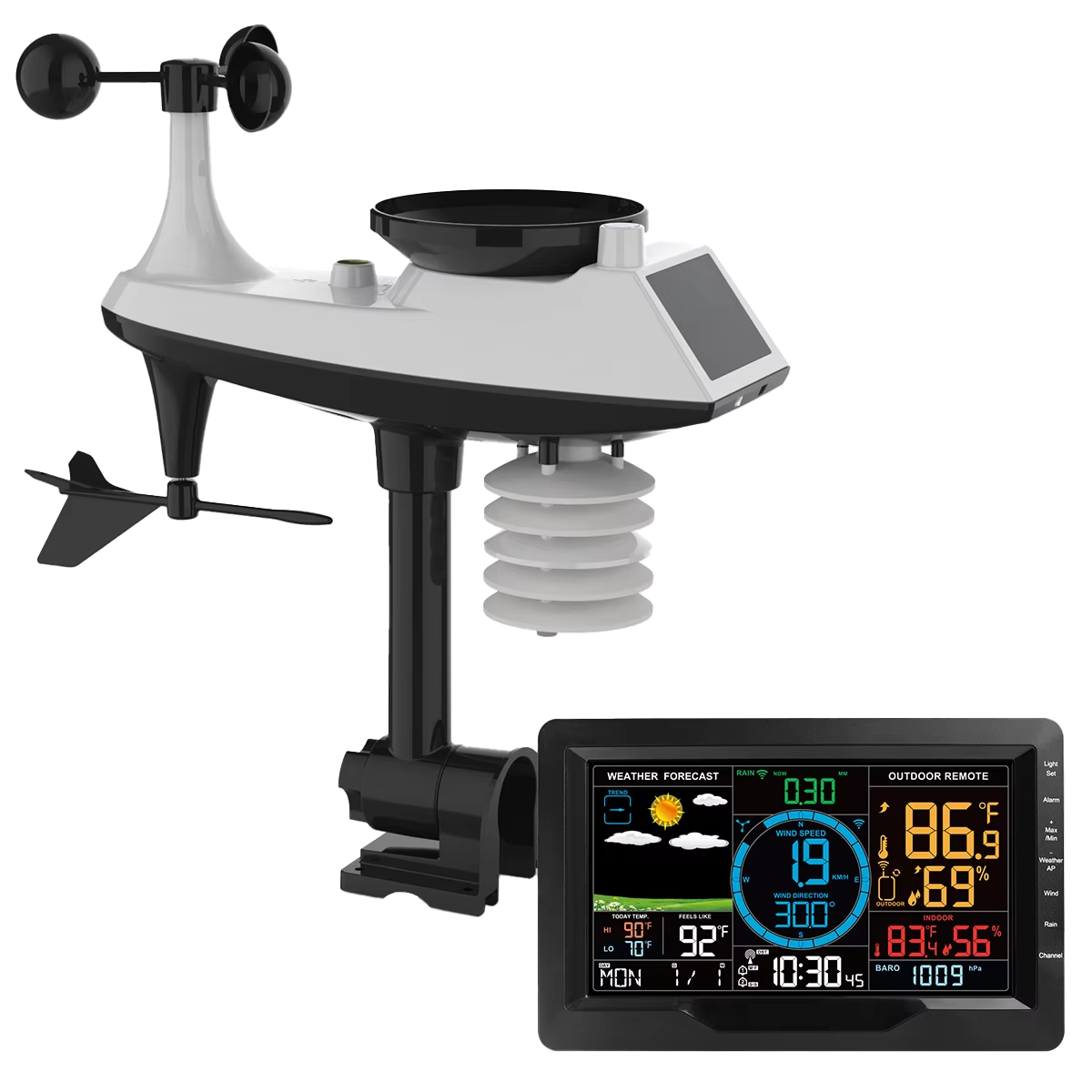
A hand-read gauge needs you outside after every storm. A tipping bucket gauge uses a small bucket that fills, tips, empties and resets, and each tip is counted as rainfall. An electronic sensor with an indoor display suits you if you are away during the day and want to check rainfall from inside the house.
AeroVault is a home weather station with an indoor display console and an outdoor wind and rain sensor. The sensor sends readings such as temperature, humidity, wind speed and rainfall to the console over its own wireless link, so no cable runs between yard and house. You mount the sensor in an open spot using the mounting hardware from the kit, and the console sits on a table or goes on a wall mount.
The console runs from the included USB power cable or from batteries, and its backlit screen offers 8 language options. It also calculates wind chill, heat index and dew point, logs past temperature and humidity values, and offers programmable alerts. The station can send your readings to an online weather network. Our guide to the automatic weather station explains how a home unit works, and the weather stations and soil collection lists the options we stock.
 In this guideAeroVault$239.99View
Common mistakes to avoid
- Placing the gauge under a tree or beside the house, where overhead cover and runoff change the catch.
- Leaving the rim tilted, which changes the opening the rain sees.
- Letting leaves, insects or dust sit in the funnel.
- Reading from above or below the water line instead of at eye level.
- Skipping the empty step, so two storms get added into one reading.
- Mixing inches and millimeters in the same log.
- Leaving a hand-read gauge out in freezing weather; check the manual for winter storage, since ice can crack a tube.
Fix those and a simple gauge gives you a record you can use to plan watering for the whole season.
Frequently asked questions
Keep reading
 Weather Stations, Soil & Outdoor ProtectionWhat Is an Automatic Weather Station? How a Home Unit Works9 min read
 Lawn, Yard & Snow CareGutter Cleaning: How to Clear Gutters From the Ground or a Ladder9 min read
 Poultry, Coop & Pest ControlMouse in a Trap: What to Do Next, Disposal and Resetting6 min read