What Is an Immersion Blender and Do You Need One?
An immersion blender is a handheld motor with a blade shaft that goes into the pot or cup. Use this checklist to decide if you need one and which specs matter.
The Cobalt Hollow Team
October 13, 2026 · 8 min read · Updated October 14, 2026
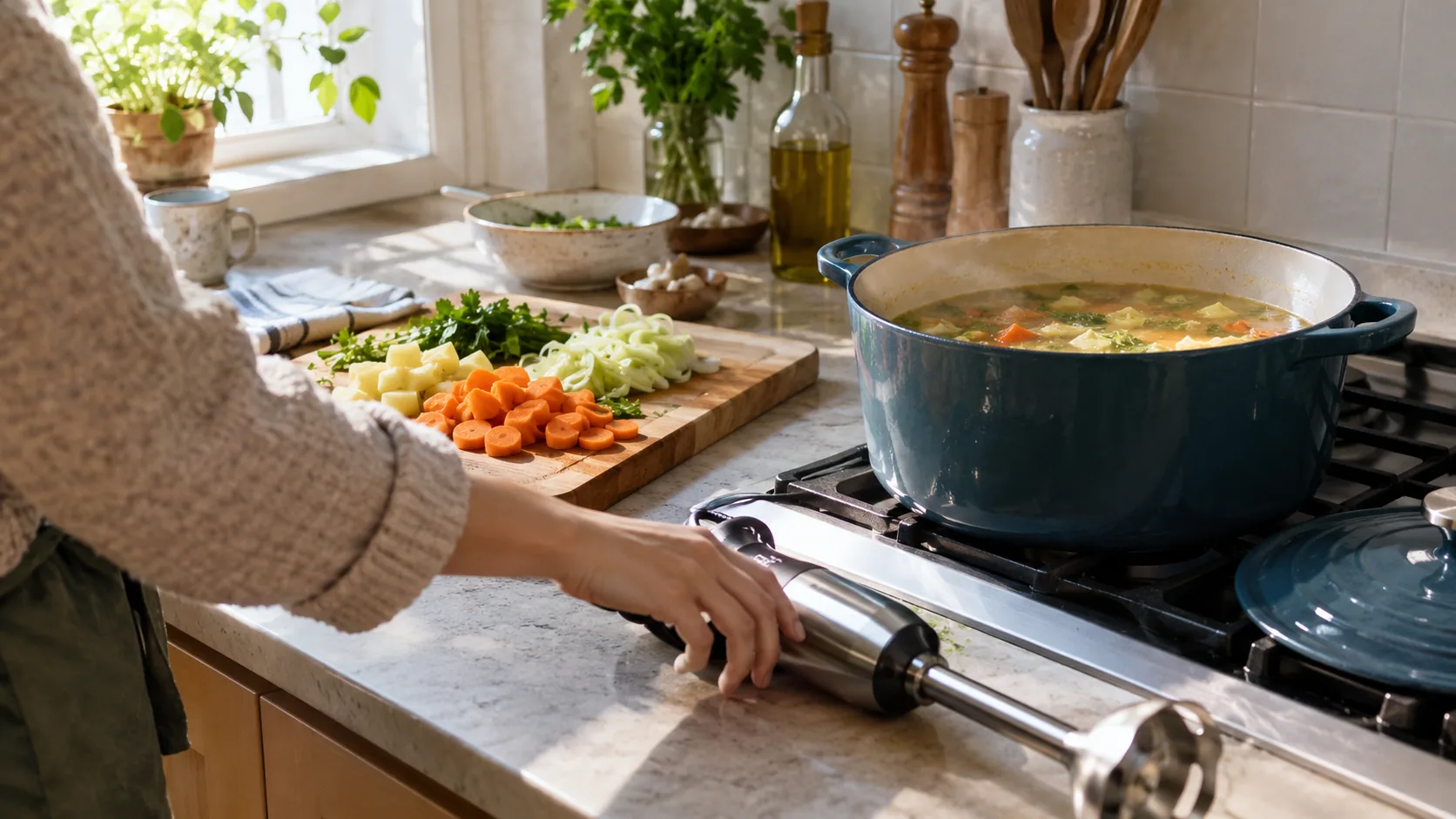
What is an immersion blender? It is a handheld, stick-shaped appliance: a motor handle with a blade at the end of a shaft that you lower straight into a pot, bowl or beaker. You blend where the food already is, instead of pouring it into a jug. If you make soups, sauces, smoothies or dressings, it is worth considering.
This guide explains how it works, which jobs it covers, and gives a decision checklist on watts, power source and attachments so you can choose before you buy.
What is an immersion blender?
The tool goes by several names. It is also called a hand blender, an immersion hand blender, a blending wand or a stick blender. All of these describe the same thing, so you can compare them freely when you shop.
To answer what is an immersion blender in one line: a motor on a stick that blends inside your own cookware. It has three basic parts:
- Motor handle: holds the motor, the speed controls and the trigger.
- Blending shaft: a tube that clicks onto the handle and ends in a blade, usually inside a guard.
- Power source: a cord that plugs into a wall outlet, or a rechargeable battery on cordless models.
The blade guard around the blade matters. It shapes how food moves around the blade and helps keep the blade from scraping the bottom of your cookware.
Because the shaft is the only part that touches the food, the tool is compact. The bulk is the handle, and the parts that get messy detach for washing. That is why it often lives in a drawer rather than on the counter.
What it does well and what it replaces
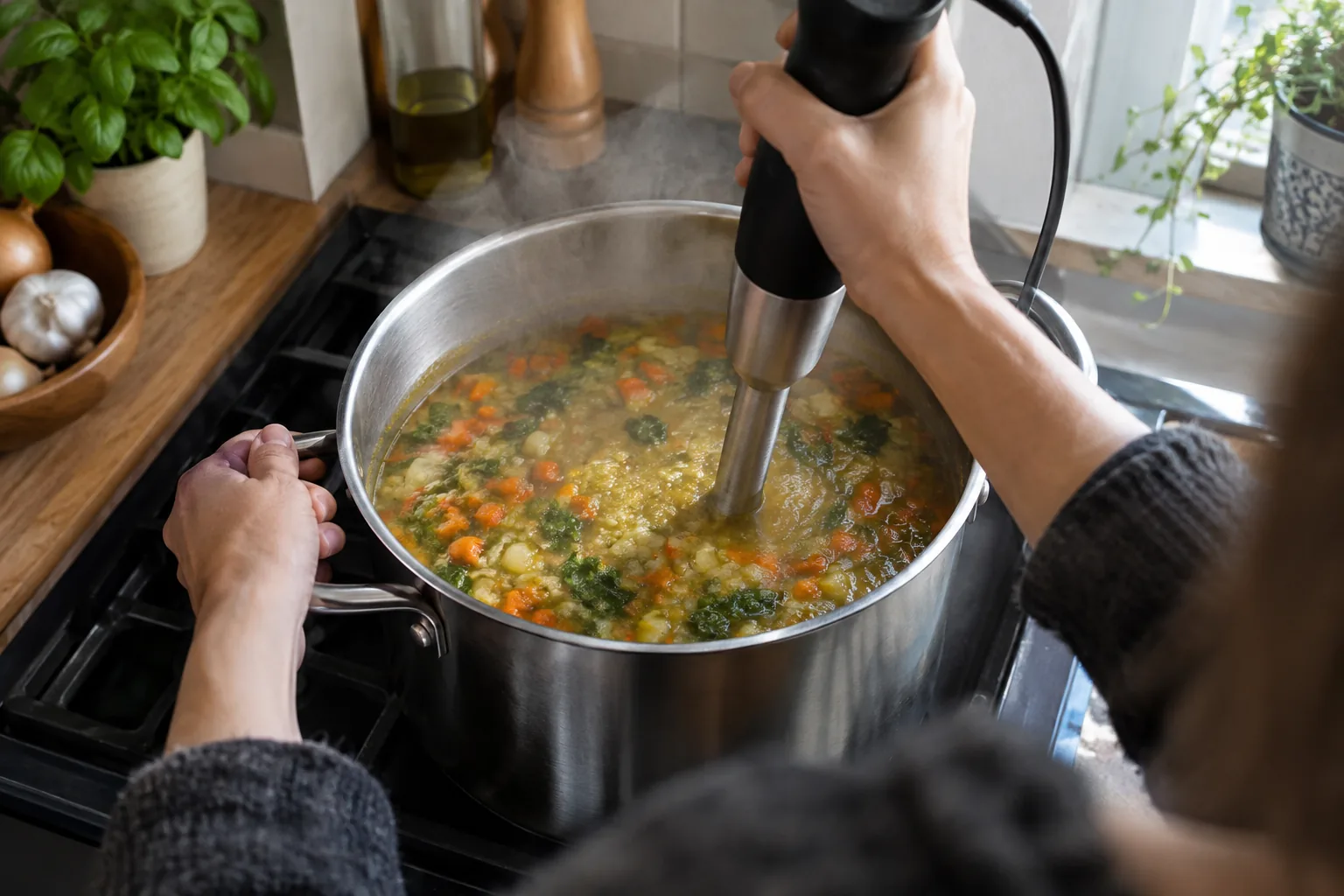
The tool suits jobs where you want to blend in the container you are already using. Typical tasks include:
- Pureeing soups and sauces right in the pot.
- Making mayonnaise, aioli and hollandaise in a narrow beaker.
- Mixing salad dressings and vinaigrettes in a blending cup.
- Blending single-serve smoothies and shakes.
- Smoothing pancake batter, gravy or hummus.
- Making whipped cream or whisking egg whites, if a whisk is included.
- Chopping onions, herbs and nuts, if a chopper bowl is included.
It does not replace everything. A countertop blender is built for large batches of frozen drinks. A stand mixer or food processor suits stiff dough and big prep jobs, and a hand mixer is the usual choice for thick batters. Solid ingredients such as raw carrots or hard cheese belong in a food processor, not under a blending shaft.
| Task | Immersion blender | Countertop blender | Food processor |
|---|---|---|---|
| Hot soup in the pot | Blends in place | Pour in batches; follow the manual on hot liquids | Pour in batches |
| Mayo or emulsions | Suits a narrow beaker | Possible with enough volume | Possible with a feed tube |
| Large frozen drinks | Small batches | Suited to the job | Not typical |
| Chopping onions and herbs | Only with a chopper attachment | Not typical | Suited to the job |
| Whipped cream | Only with a whisk attachment | Check the manual | Some models |
| Storage space | One drawer | Counter or cabinet | Cabinet |
Do you need an immersion blender? A decision checklist
Work through these steps in order.
- List what you cook weekly. If soups, sauces, curries or purees appear often, an immersion blender fits. If you mostly make large frozen drinks, a countertop blender may serve you better.
- Count your dishes. If pouring hot soup into a jug and washing it feels like a chore, blending in the pot skips that step.
- Check your storage. A stick blender fits a drawer. A kit with attachments needs a small shelf or a case.
- Check your cookware. Deep pots and a tall beaker work well. Shallow pans can lead to splatter. Some nonstick or enameled surfaces can be scratched by a blade, so check your cookware's care instructions.
- Decide on attachments. A whisk and a chopper bowl turn one motor into several tools. If you already own a food processor and a hand mixer, you may only need the blending shaft.
- Choose corded or cordless (covered below), then compare wattage and included parts.
If you answered yes to the first two steps, you will likely use one often. If you rarely blend anything, skip it.
Field note
Not sure yet? List the last five recipes you cooked. If two or more involved blending, mashing or whisking something in a pot or bowl, a stick blender has a clear job in your kitchen.
Watts, corded or cordless, and attachments
How many watts should an immersion blender have?
Wattage is the power rating of the motor, such as 1200W. It is one spec among several, not a full picture of how a blender will perform. Blade shape, guard design and shaft length also matter.
- Lower wattage models suit light jobs such as smoothies, pancake batter and small sauces.
- Mid-range models suit regular soup and sauce blending.
- Higher wattage models are generally aimed at larger pots, fibrous greens and ingredients like frozen fruit.
Look at multiple speeds as well. Some models offer five speed settings, others six, and some add a turbo button. A dial lets you start gently and step up, and starting low helps keep liquid in the pot.
Corded or cordless?
A cordless immersion blender runs on a rechargeable battery, so you can move around the kitchen or blend away from an outlet. You need to charge it, and battery behavior varies by model, so read the manual before you rely on one for a long job.
Corded models plug in and run while they are connected. The trade-off is the cord, which must reach your outlet and stay clear of the stove and any hot surface.
| Factor | Corded | Cordless |
|---|---|---|
| Power source | Wall outlet | Rechargeable battery |
| Mobility | Reach depends on cord length | Move freely |
| Planning | None beyond outlet access | Charge before use |
| Suits | Regular cooking at the stove | Occasional use, small kitchens, blending away from outlets |
If you cook large pots of soup regularly, corded fits that routine. Cordless suits a need for reach and tidy counters, and whether it is any good for you depends on the jobs you give it and on the charging habit you keep.
Attachments and materials to check
- Shaft material: stainless steel is common and works in hot pots. Plastic shafts can be a concern with heat, so follow the manual.
- Blade guard: a guard helps limit scraping on cookware.
- Beaker: a tall, narrow beaker helps with emulsions and single servings.
- Chopper bowl and whisk attachment: useful if you want one motor for several jobs.
- Cleaning: look for detachable parts, and check whether the manual allows dishwasher cleaning.
- Storage: a case or a small set of parts keeps everything together.
Ice and frozen ingredients
If you want to know whether a handheld immersion blender can handle crushed ice or frozen fruit, that depends on the model, so read the manual for which ingredients the maker lists. Let frozen pieces thaw slightly, add liquid, and use a deep beaker so the blade stays covered.
Spec checklist to take shopping
Use this table to compare any two models side by side. Fill in each row from the product page or the manual.
| Check | What to look for | Why it matters |
|---|---|---|
| Motor wattage | The listed figure, such as 1200W | Gives a rough sense of the intended workload |
| Speed control | A dial or several settings, plus turbo if offered | Lets you begin low and step up |
| Shaft and blade | Stainless steel, a guard around the blade | Suits hot pots |
| Attachments | Whisk, chopper bowl, beaker | Decides how many other tools it can stand in for |
| Power | Cord length or battery charging | Decides where you can use it |
| Cleaning | Detachable parts, dishwasher guidance | Sets how much washing is involved |
| Storage | Case or compact parts | Keeps drawers tidy |
Dressings, egg whites and whipped cream
These small jobs are where the attachments earn their place. For salad dressings, put the oil and vinegar in a tall beaker, submerge the blade and start on a low speed so the mixture comes together smoothly.
For egg whites and whipped cream, swap the blending shaft for the whisk. Use a clean, dry bowl and follow the manual for the speeds it suggests. Keep the blade shaft out of these jobs, because it chops rather than aerates.
Two corded kits we stock
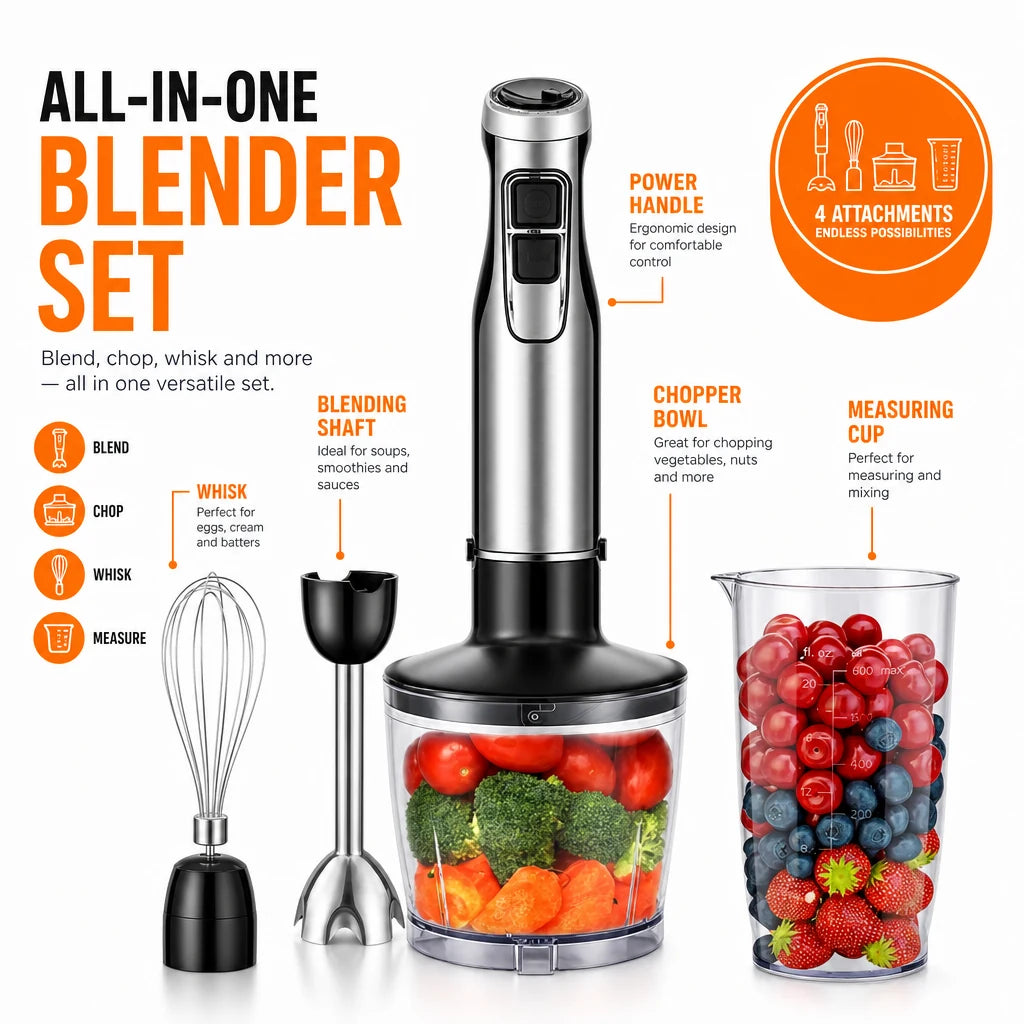
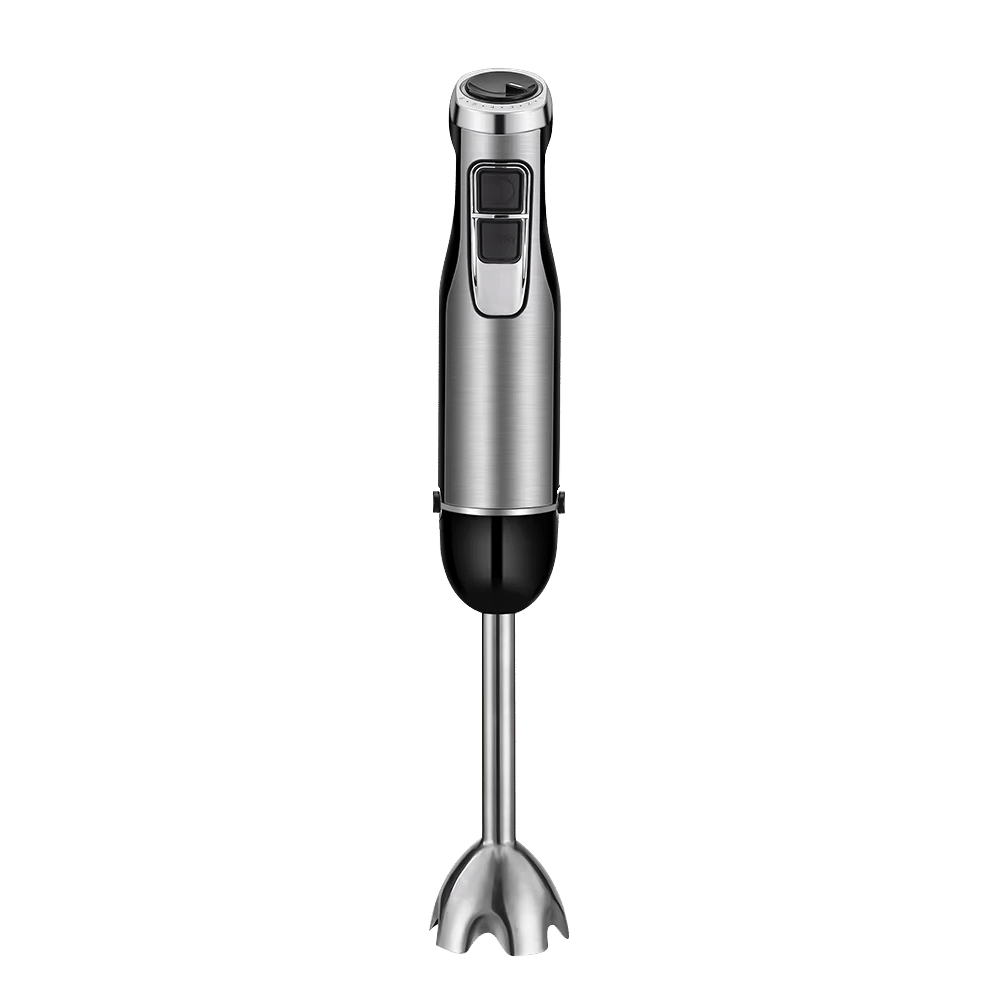
Both of these are corded kits with a 1200W motor, a blending shaft, a whisk, a chopping bowl and a beaker. They differ in the details.
BrothForge has a stainless-steel shaft with a sealed bearing and a scalloped, bell-shaped guard around the blade. It has six speeds plus turbo, a non-slip silicone grip, a 500ml chopper bowl, a 600ml beaker and a quick-release coupling. Its use steps call for turbo with frozen fruit, ice cubes or fibrous greens, and the detachable parts can go on the dishwasher top rack.
 In this guideBrothForge$199.99View
Culinox Pro also has a 1200W motor base with 6 speeds plus turbo. Its blades are 304 stainless steel on a stainless steel shaft, the handle is ergonomic for longer prep work such as a large pot of soup, and a storage case holds the attachments together, which helps if drawer space is tight.
 In this guideCulinox Pro$119.99View
To compare other kitchen tools, browse the Blenders, Mixers & Prep Tools collection.
How to use an immersion blender without splatter
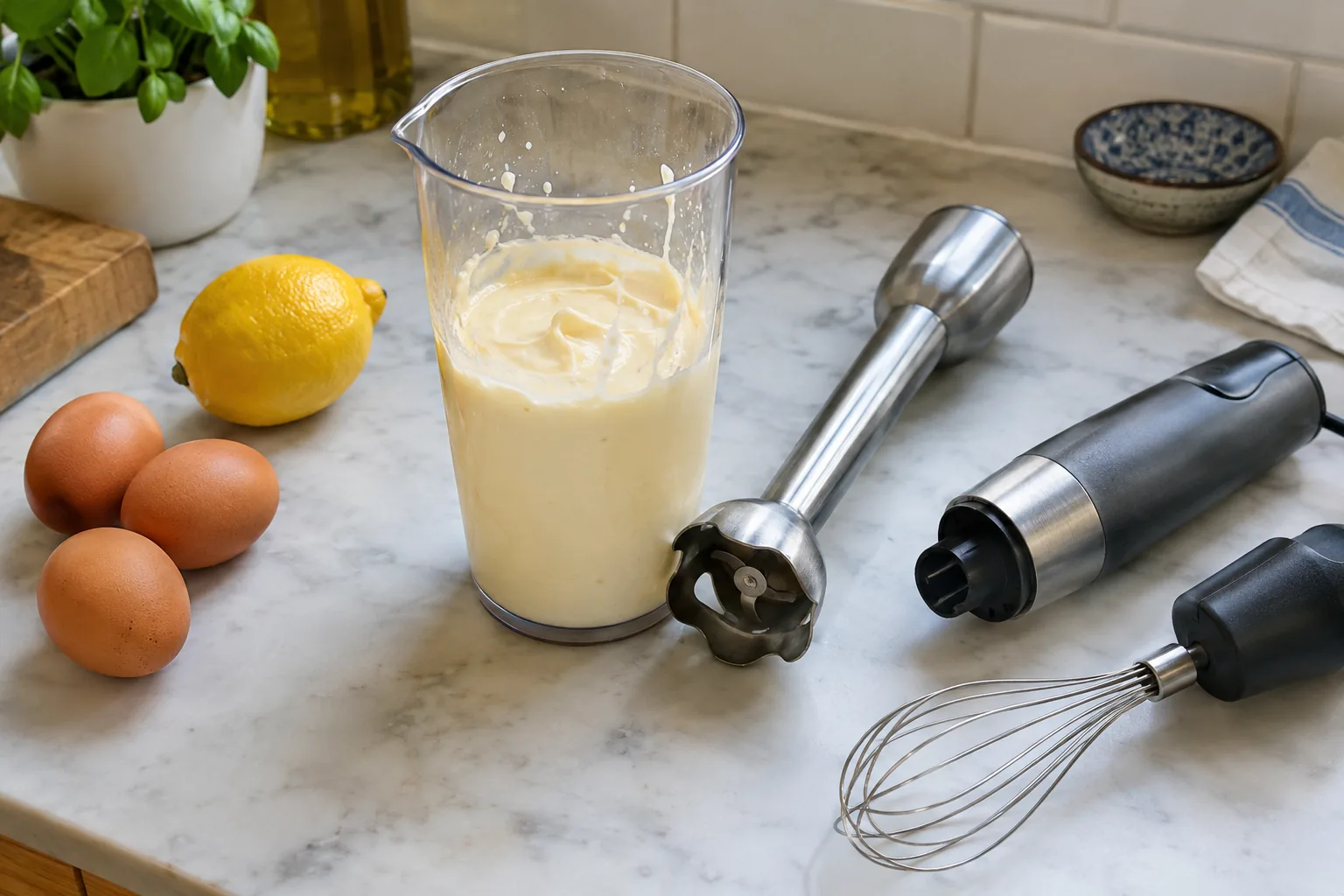
- Attach the shaft to the motor handle until it clicks.
- Choose a deep pot or a tall beaker.
- Submerge the blade fully before you press the trigger.
- Start on the lowest speed, then step up as the recipe needs.
- Move the blender slowly up and down to draw food toward the blade.
- Release the trigger before lifting the blade out of the food.
For hot soup, take the pot off the heat first and work in small amounts if the pot is very full. Hot liquid can splash, so check your manual for fill limits.
Common mistakes
- Lifting the blender while it runs. This throws food across the kitchen.
- Blending in a shallow pan. Use a deeper container.
- Starting on a high speed. Begin low, especially with thin liquids.
- Dunking the motor handle. Only the shaft goes into the food.
- Skipping the manual. Use limits and care steps vary by model.
Care and cleaning schedule
- After each use: unplug the unit (or switch off a cordless model as its manual directs), then detach the shaft and rinse it. Wipe the motor handle with a damp cloth. Do not submerge the handle.
- After greasy or sticky jobs: wash the shaft, whisk, chopper bowl and beaker with warm soapy water, or use the dishwasher top rack if the manual allows it.
- Weekly if used often: check the cord or battery, the coupling and the guard for damage. Stop using it if anything looks cracked or loose.
- For storage: dry all parts and keep them together in a case or drawer.
If you have questions about electrical issues, ask a qualified electrician, and always follow the manufacturer's instructions.