Water Distiller Home Use: How It Works and What to Check
A countertop distiller boils tap water and collects the condensed vapor. Use this checklist to compare capacity, cycle time, energy use, materials and descaling care.
The Cobalt Hollow Team
October 28, 2026 · 7 min read
A water distiller home unit heats tap water in a chamber until it turns to vapor, then cools that vapor back into liquid and collects it in a carafe. Minerals and metals do not rise with the vapor, so they stay behind in the tank as residue. Before you buy, compare capacity, cycle time, energy use, materials and how you will descale the unit.
This guide explains the process, gives you a checklist you can run against any model, and covers the care routine that keeps a distiller working.
How a home water distiller works
Every countertop distiller follows the same path. You fill the boiling chamber with ordinary tap water and start the heater. The water boils, and water vapor rises toward a cooling section. There it condenses and drips into a collection container.
Minerals and metals do not rise with the vapor. They remain in the tank as a visible residue that you rinse out after the run. Many units add an activated carbon filter in the vapor path before the carafe, which is a separate stage from the boiling itself.
Distilled water vs. steam distilled water
The two terms describe the same thing. Steam distilled water is water that was boiled, turned to steam, and condensed again, which is what distilled water means. The extra word "steam" only names the step that happens inside the machine.
Distilled water is different from filtered water, which passes through a medium such as carbon but is not boiled. It also differs from the output of a membrane system. If you are weighing both approaches, our guide to countertop reverse osmosis water filter systems explains how that method works.
Water distiller home checklist
Use this table to compare any two models. Each row is something you can read off the product page or the manual.
| Check | What to look for | Why it matters |
|---|---|---|
| Capacity per cycle | Liters or quarts the chamber holds and the carafe collects | Sets how many cycles you run for your household |
| Cycle time | Hours per full batch, as the manual lists it | Decides whether you run it overnight or during the day |
| Power draw | Wattage on the label or spec sheet | Lets you work out energy use per batch |
| Interior material | Food-grade stainless steel chamber | This is the surface that holds boiling water |
| Collection container | Glass carafe or another material | Decides how you store the finished water |
| Controls | Temperature and timer settings | Lets you start a run and leave the unit |
| Filter packs | Carbon packs included, plus replacement supply | The filter is part of the vapor path |
| Cleaning method | Cleaning powder or a method the manual lists | Scale builds up in the tank |
Capacity and cycle time
Capacity has two numbers: what the boiling chamber holds and what the carafe holds. Check that they match, because a chamber larger than the carafe means you have to empty it mid-run.
Work backward from your own use. If you drink and cook with a gallon (about 3.8 L) a day, a small unit needs more than one cycle every day. If you only need distilled water for an iron, a humidifier or a few kitchen tasks, one batch can last several days.
For cycle time, find the figure in the manual rather than the headline spec. A timer setting matters here, since it lets you start a batch when you leave and collect it later. Distillation is a slow process by design, so plan batches around your day instead of expecting water on demand.
Materials and parts to inspect
Look at what touches the water at each stage. The boiling chamber should be stainless steel that is described as food-grade. The collection container is the other contact point, and glass lets you store water without buying it in plastic jugs.
Check the lid seal, the condenser area and the carafe opening. These are the places that get wet and warm, so they need regular rinsing. Ask whether replacement carbon filters are available, since the carbon stage is part of the vapor path to the carafe.
Energy use and the cheapest way to distill water
A distiller keeps a heating element running for the whole cycle. To estimate cost, find the wattage on the label, multiply by the hours in a cycle, then divide by 1,000. The result is kilowatt-hours per batch. Multiply that by the rate on your electric bill.
Run that math for each model you are considering. A unit with a timer or temperature control gives you more say over how long the heater runs. Keep in mind the figure covers only electricity, not filters or your time.
Stovetop method
The lowest-cost way to distill water is a pot on the stove. Put water in a large pot, set a heat-resistant bowl or cup on a rack inside so it floats above the water line, and cover the pot with an inverted lid. Ice on the lid helps vapor condense and drip into the bowl.
This works for small amounts but needs attention the whole time. You are working with boiling water and steam, so keep children away, use oven mitts, and do not leave the pot unattended. A countertop unit takes over the heating, condensing and collecting for you.
A countertop example: ClarityStill
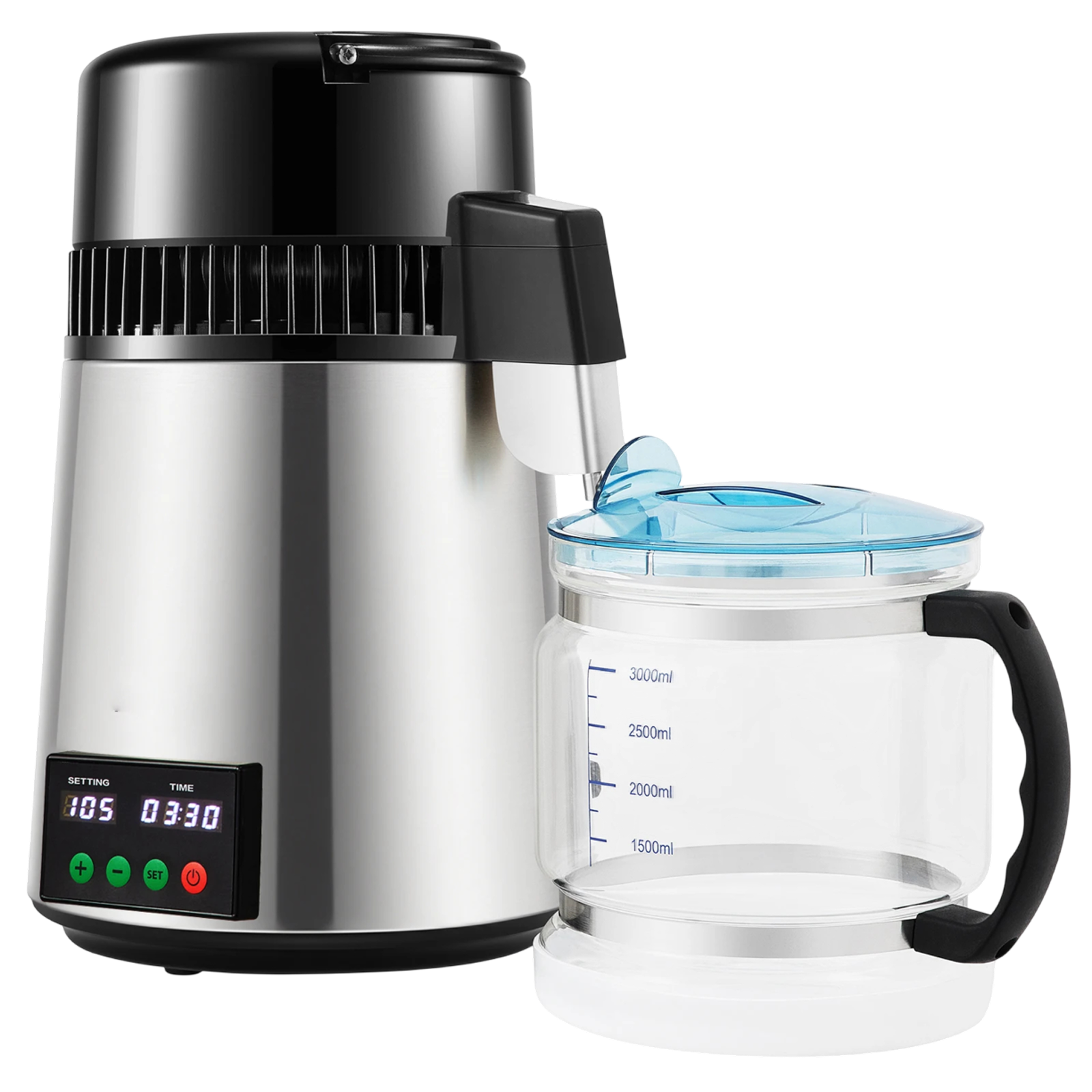
The ClarityStill is a countertop home water distiller built around the steps above. It has a stainless steel interior, and a single touch screen lets you set the temperature and a timer for each run. You fill the chamber with tap water, start a cycle, and let it heat while you do other things.
Vapor cools, passes the carbon filter and collects in the included glass carafe. The box also holds three activated carbon filter packs, a fruit-based cleaning powder and a quick-start user manual. Because minerals stay in the tank, you rinse out the residue you can see after a run.
 In this guideClarityStill$249.99View
Descaling and care routine
Residue is the visible sign that the distiller is doing its job, and it needs removing. Left in place, mineral deposits build up on the tank floor and the heating area, which makes cleaning harder later. Unplug the unit and let it cool fully before you touch it.
After every run
- Unplug the distiller and let the chamber cool.
- Pour out any water left in the tank.
- Wipe or rinse out the residue with a soft cloth or sponge.
- Rinse the glass carafe and let it air dry.
- Leave the lid off or ajar so the interior dries.
Periodic descaling
Hard tap water leaves more scale, so descale on a schedule that matches your water and how often you run the unit. Use the cleaning method listed in the manual. A unit that ships with a cleaning powder is telling you which product the maker expects.
If you want to use household vinegar instead, check the manual first. Some makers allow a diluted acid soak, and others specify their own cleaner because of seals or finishes. Rinse several times afterward so no taste remains. The same descaling logic applies to other heated appliances, and our piece on tankless water heater maintenance walks through flushing and scheduling.
Replace the carbon filter packs on the schedule in the manual, and keep spares on hand so you do not skip a change.
Field note
Write the date of each descaling on a piece of tape inside a cabinet door. After two or three cycles you will see how quickly your tap water builds scale and can set your own interval.
Common mistakes to avoid
- Buying on capacity alone and skipping the cycle time, which leaves you short on batches.
- Putting the unit near a wall or cabinet that traps steam and heat.
- Leaving residue in the tank between runs until it hardens.
- Storing finished water in a container that was not cleaned first.
- Ignoring the manual's list of what the unit is meant to process.
Can a water distiller distill alcohol?
A home water distiller is built for water. Do not put wine, beer or any other liquid into it unless the manual says you can, since the seals, heating settings and carbon filter are specified for tap water.
Distilling spirits is also regulated in the US, at both federal and state levels. If you are curious about it, check the rules where you live first, and do not repurpose a water unit for it.
Where distilling fits among other options
A distiller is one way to purify water at home. Filters, pitchers and under-sink systems work differently, and each has its own upkeep. If you plan a whole-kitchen setup, browse our food storage, cookware and water filtration collection to see the other pieces.
If your goal is simply a supply of distilled water for appliances, a distiller makes sense because you decide when to run it. If you want drinking water on demand at a tap, a plumbed system may match your habits. Decide based on the quantity you use, the counter space you have and the care you are willing to do.